Fort Siloso — Glossary

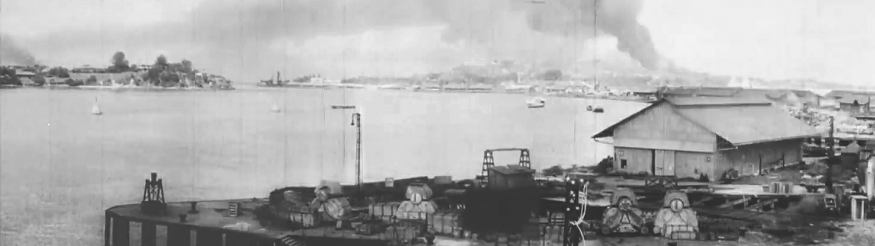
Keppel Harbour February 1942. Fort Siloso Top Left
From a Japanese Propaganda Film
”
Shorthand for an inch (2.54cm)
AMTB
Anti Motor Torpedo Boat. Originally A/CMB — Anti/Coastal Motor Boat.
AP
Armour Piercing. A shell with a thick casing designed to penetrate the armour of a ship and explode internally. The Fuze was in the base of the shell so that it was not crushed in the passage of the shell through armour. Some other types of shell such as Common Pointed had a base fuze.
A Ballistic Cap was fitted to the nose of the shell. This was lightweight and streamlined to assist passage through the air. On impact, the shell would simply pass through the Cap and on to the armour beyond.
Auto Sight
A telescope sight attached to the gun mounting. Simply aiming at the waterline of the target, she sight would fix the range by using the height of the gun above sea level and the angle to the target.
BC
Battery Commander.
BL
Breech Loading. The shell and propellant charge, normally in cartridge or bagged form, are inserted from the breech (rear) end of the gun. This meant that longer barrels with greater accuracy could be used.
BOP
Battery Observation Post.
BPR
Battery Plotting Room
Calibres
In the context of artillery guns, the length of the barrel is given as Calibres. A calibre is the diameter of the bore (6-Inch, 8-Inch, 9·2-Inch etc) divided by the actual length of the barrel. For example the Mark VIIa 8-Inch BL Gun had a length of 208 inches. divide 208 by 8 and the result gives a calibre of 26. The gun can then be described as an 8-Inch Gun of 26 Calibres.
Caponier
A covered passageway projecting into or completely across a ditch of a fortification. Its purpose was to provide a flanking fire along the ditch.
Cartridge
The charge which propels the shell from the gun. It was in a bag, usually silk, and came in various weights depending on the gun and range required. The charge in the early days was Prismatic Powder, later Cordite.
Cartridge, or Round also applies to small arms (pistols & rifles) ammunition and refers to the propellant charge, primer, percussion cap and projectile all being in one unit. The word ‘bullet’ is often erroneously used to describe a cartridge. Some artillery shells were in this form as well; 3-Pounder, 6-Pounder and 18-Pounder for example.
Cascabel
A part at the rear of a muzzle loading cannon where ropes could be attached to arrest the recoil movement of the cannon. When on a Platform of Sliding Carriage, the Cascabel was redundant.
CASL
Coast Artillery Searchlight.
CFD
Commander Fixed Defences.
Chilled Shot
Projectiles cast in sand moulds rather than the then practice of using hot iron moulds.
Close Defence Battery
A coast battery designed for use in short range engagements with vessels such as destroyers and mine-layers.
Cordite
Cordite was a smokeless propellant made from nitroglycerine and nitrocellulose. It was extruded in to long strips, rather like a cord. The strips were bundled together to make propellant charges.
Counter Bombardment Battery
A coast battery designed to engage heavy warships up to and including battleships at long range.
CP
Command Post.
CPM
Centre Pivot Mounting.
DEL
Defence Electric Light (searchlight).
DPF
Depression Position Finder. A very complicated piece of equipment which was used to calculate the range and position of a target. Invented by Capt. H.S. Watkin of the Royal Artillery during the 1880s. He invented the DRF at the same time, having commenced his work during the 19870s.
DRF
Depression Range Finder. An optical instrument used to obtain the range of a target. These were installed at a great a height as was possible. The angle of depression which set the sights on the target's waterline was used to calculate the range by means of trigonometry.
FC
Fire Command.
Fuze
A small device which initiates the detonation of a shell or munition. Fuzes may be instantaneous, have a delay mechanism, or may be set to initiate in the proximity of a target.
Gunpowder
Gunpowder is a mixture of saltpetre, charcoal and sulphur. It explodes at a temperature of 600°F (316°C). The explosiveness depends on the rate at which it burns, which is mainly dependant on the size and density of the grain.
H.K.S.R.A.
Hong Kong & Singapore Royal Artillery
Holdfast
A circular array of high tensile bolts embedded vertically in concrete. To these bolts were fastened a gun mounting. The length of the bolts varied according to the gun type.
Prismatic Powder was made from grain pressed into hexagonal or octagonal pieces. This gave better burning characteristics, and was safer than gunpowder, producing less smoke.
RLG (Rifle Large Grain Powder was of pressed powder 4 to 8 grains in size. The size was achieved by sieving the powder to extract grains of the correct size.
P (Pebble) Powder was larger than RLG and produced in rounded edge ⅝ inch cubes with 5 to 7 grains to the pound (·45kg).
HE
High Explosive. The Shell has a powerful explosive filling and the fuze was in the nose of the shell. It was designed to explode on impact and scatter lethal shards of metal.
Magazine
A place to store shells and cartridges. Usually underground with shells and cartridges being kept in separate thick walled rooms.
ML
Muzzle Loading. Early cannon had their propellant charge and cannon ball or shell loaded from the muzzle. The bore of these guns was smooth, until the advent of rifling.
OC
Officer Commanding.
OP
Observation Post
OR/IOR
Other Ranks. Indian Other Ranks.
PF Cell
Position Finding Cell. Instrumentation in these took bearings on the target. The bearings were used in conjunction with other Cells and a Range Finder to accurately plot the position and course of a target vessel.
QF
Quick Firing. The Shell and propellant cartridge were usually all in one unit, a brass case containing the propellant charge, firing cap and primer with the shell on the open end. The whole unit was called a Round of Ammunition. This gives a very fast rate of fire. The smaller guns in Singapore used this type of ammunition.
The 6-Inch QF used ‘Separate QF’. The appropriate weight of bagged propellant charge was in the brass case with the shell separate. One man would insert the shell, a second the brass case containing the propellant. The breech was closed and the gun fired. There was no need for priming charges. Separate QF was required as the combined weight of the 6-Inch Shell, propellant charge and brass case would be difficult to handle.
R.A.O.C.
Royal Army Ordnance Corps.
An Ancestor of the Royal Logistic Corps. Responsible for stores and ordnance among other things. Although not usually in to construction, they were responsible for building the Buona Vista Battery.
R.A.S.C.
Royal Army Service Corps, another ancestor of the Royal Logistic Corps. Responsible for a range of activities especially transport and the aerial delivery of supplies.
R.E.
The Royal Regiment of Engineers. Gun emplacement construction and bridge building were two of the responsibilities of the Engineers.
RLG Powder
Rifle Large Grain Powder. Gun powder with grains small enough to pass through a sieve with four square meshes to the inch, and large enough to be held by 8 meshes to the inch.
RML
Rifled Muzzle Loading. A set of grooves are cut in to the inside face of the barrel. Studs on the shell fitted into the grooves and imparted a spin to the shell when fired. This greatly increased accuracy.
SLDS
Searchlight Director Station.
Tampion
A plug or a cover for the muzzle of a gun. Some were decorated with such designs as ship’s badges.
Trunnions
Two small cylindrical protruding from the sides of a gun near the centre of gravity. They allowed the barrel to be elevated.
Trunnion Level/Height
This is the height of the swivel point of a gun above mean sea level.