Fort Siloso: The Guardroom

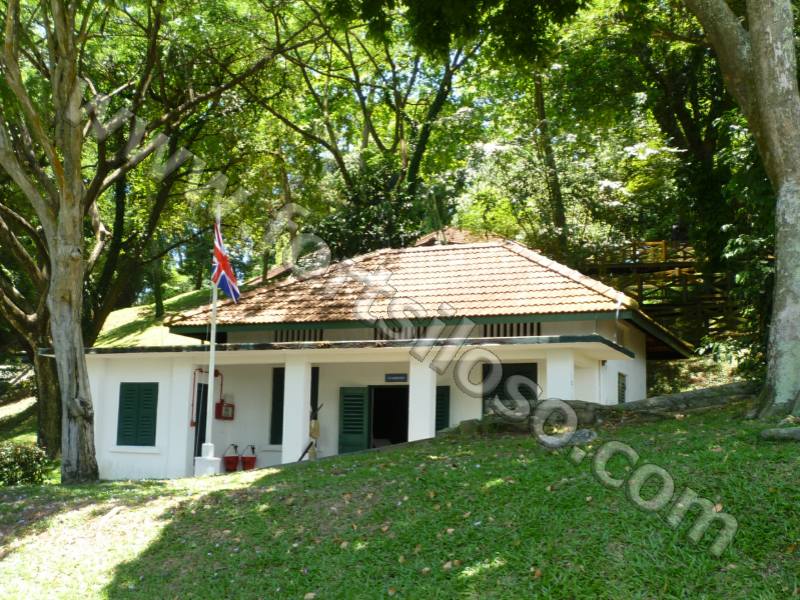
The Guardroom
Most likely just before the turn of the 20th Century, when fort was being upgraded, a building was constructed by the road leading from the pier into the fort. The building appears on fort plans of 1910. This building became accommodation for 18 RE (Royal Engineers), probably the men who operated the Submarine Mining Establishment. In later years, the building became an Officers’ Shelter. It is unlikely that the building was ever used as a guardroom.
A Guardroom is a building where soldiers who are tasked with guard duties stay during their period of duty. The guard will normally consist of a Guard Commander who is an NCO, and a certain number of men. The actual number depends on the size of the area to be guarded. During their period of duty, men will be sent out to patrol, called ‘Stag’ in the army. Others will man the camp gates. Men not on the gates or on patrol will rest in the Guardroom.
Some Guardrooms had cells for soldiers under arrest, or serving short periods of incarceration.
The First Guardroom
The first known guardroom at Fort Siloso was a small building, labelled as a Guard Bungalow on contemporary plans of the fort. This Bungalow was located on Mount Siloso, to the east of the buildings currently there, and to the north of the Skywalk. At that location, a track entered the fort from the direction of Middle Hill (Mount Imbiah). Close to the bungalow was a water tank and an attap shed.
The fort was protected by an iron fence which ran in a dog-leg shape, from a point between the pier and the 7 Inch Gun Emplacement to the Guard Bungalow at the bend of the leg, and then on to the cliff on the south of the fort. There was also a gate between the pier and the gun emplacement.
Close to the Guard Bungalow, but outside the fence on the track, was an attap ‘Shed’ for troops, a Cookhouse and a Washhouse.
It don’t know when this Guard Bungalow was abandoned, but I do know that it was still in use in 1919.
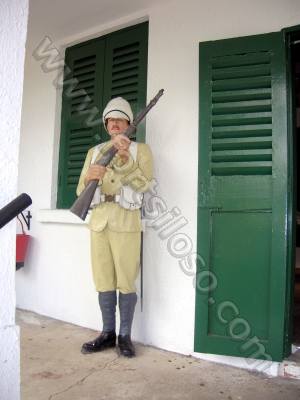
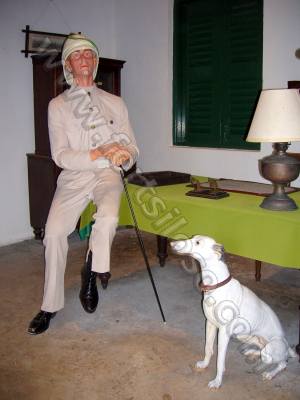
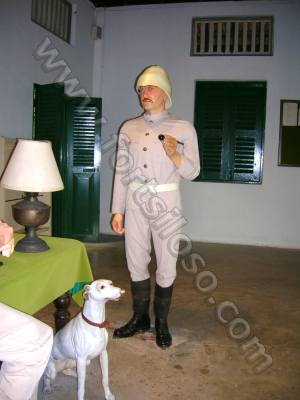
In the Guardroom; A soldier on guard, The Orderly Officer, BSM Cooper reports to the officer
The figure of a soldier on duty is holding his rifle at the ‘Port’. In reality, he probably would have been at the gates, and in a Sentry Box. He would normally be standing at ease with his rifle resting butt on the floor.
The soldier’s rifle, A Martini Henry Artillery Carbine, would only be raised when being placed in the ‘Challenge or On Guard’ position to check an unknown person approaching. To salute an officer, the carbine would be Shouldered and the right arm placed horizontally across the body with the palm of the hand on the butt of the weapon. A Field Officer would receive a ‘Present Arms’.
From the Drill Manual for the Martini Henry Rifle, 1877.
Present arms (3)
ONE: Twist the rifle 90° to the right in the left hand, grabbing it at the wrist in the same moment with the right hand.
TWO: Hoist up the rifle in front of the body high enough that you can see through the trigger. The left hand will be held against the rifle while the right does the supporting, keeping the elbows in close together.
THREE: Step back with the right foot and sharply bring the rifle down, grasping it with the left hand that the forearm is parallel to the ground. The right hand will be at the wrist, between the thumb and hand, fingers extended.
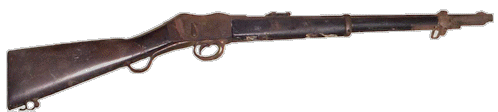
A Mark II Martini Henry Artillery Carbine
This particular weapon was found in one of the blocks at the Parade Square on Sentosa during Renovations. Someone must have been Court-Martialled for losing this.
The Last Prisoner
Detained under the Internal Security Act for alleged involvement with the Communist Party of Malaya (CPM), Mr Chia Thye Poh, spent three years living in the Guardroom from 1989 until 1992.